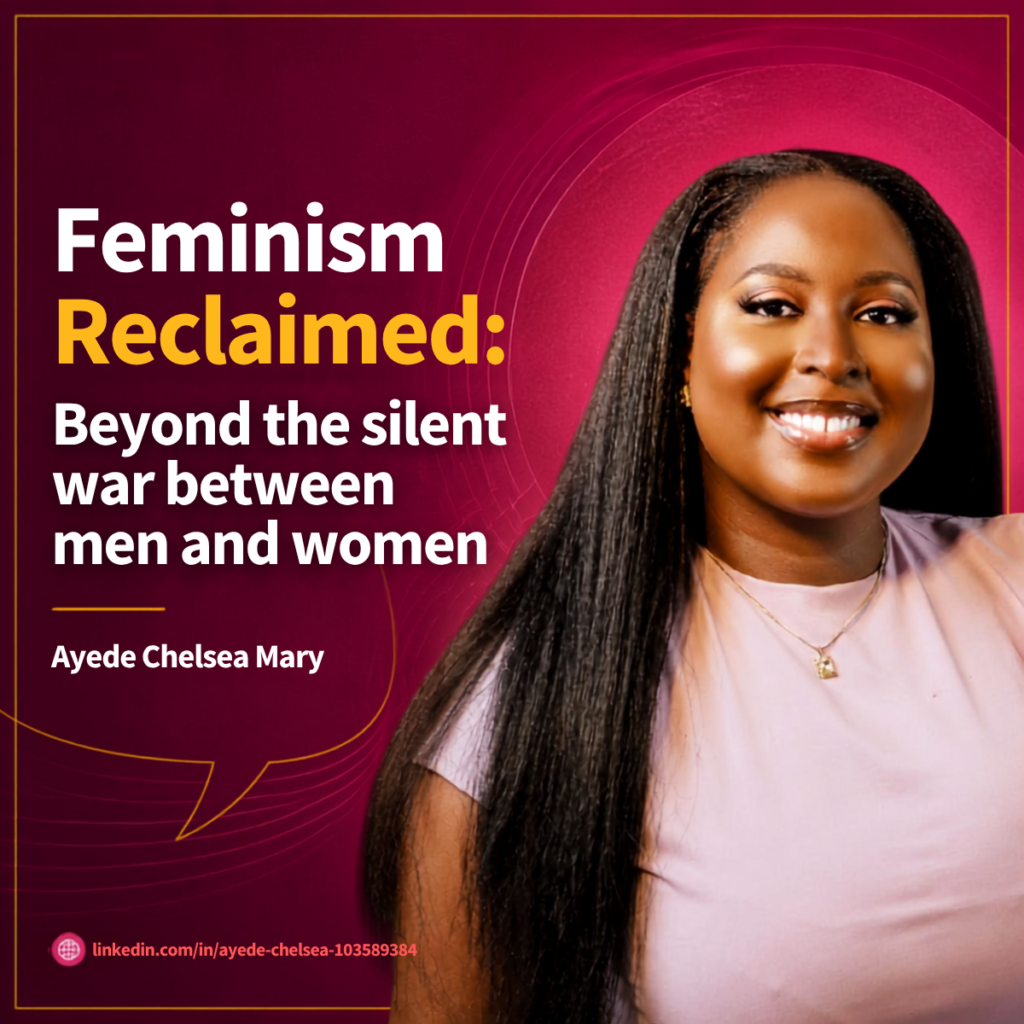
FEMINISM RECLAIMED: BEYOND THE SILENT WAR BETWEEN MEN AND WOMEN
For generations, many women across different societies have been expected to define their worth primarily through the roles they play in the lives of others, as wives, mothers, or caregivers. In many African communities, although experiences differ from one culture to another, girls have often been raised with the expectation that their ultimate achievement is to marry well and build a home.
Many young girls grow up hearing statements such as, “Is this how you will behave in your husband’s house?” or “Men don’t like women who talk back,” “Men don’t like women who are too ambitious.” Whether spoken with good intentions or not, such messages often teach girls that their value lies in how well they meet the expectations of others rather than in developing their own gifts, character, and purpose.
For many women, opportunities to make important decisions about education, careers, finances, or even their own futures were limited by social expectations and traditions that placed authority almost exclusively in the hands of men. At the same time, boys were not always taught with equal emphasis how to value women as partners deserving of dignity, respect, and equal humanity. In many settings, this imbalance created a culture where men were viewed as the ultimate prize and women were expected to adapt themselves to fit into a man’s life.
As a result, countless women accepted unhealthy or unfair conditions because they believed preserving a relationship was more important than preserving their dignity. Financial dependence often reinforced this reality, as many women had limited access to education, property ownership, or meaningful economic opportunities.
The Turning Point: When Women Said, “We Deserve More”
Against this backdrop, courageous women began advocating for change. The feminist movement emerged not because women hated men, but because women believed they deserved the same dignity, opportunities, and fundamental rights enjoyed by men. At its heart, feminism sought access to education, employment, property ownership, political participation, personal safety, and the freedom to make decisions about one’s own life.
Its central message was simple: a woman’s humanity is not determined by whether she is chosen by a man. She is already complete and worthy. That vision transformed countless lives around the world.
Where Conversations Have Become Polarized
In recent years, however, public conversations about feminism have become increasingly polarized in some spaces. Social media, cultural debates, and political disagreements have sometimes reduced complex issues into an unhelpful battle of men versus women. Some people mistakenly interpret feminism as a movement that seeks female superiority over men. Others view it as a threat to men’s identity or role in society. Neither understanding
reflects the movement’s original purpose.
The result has been endless online arguments, stereotypes, ridicule, and defensive attitudes from both sexes. Yet feminism was never intended to diminish men. It was intended to ensure that women were no longer diminished. Its goal has always been equality of dignity and opportunity, not domination.
Returning to The Original Vision
Perhaps it is time to return to the movement’s original purpose. Every human being possesses inherent dignity and value. Whether viewed through faith, philosophy, or basic human rights, men and women are equal in worth. Societies flourish when people contribute according to their abilities and character, not when opportunities are limited because of gender.
No one should become a slave to outdated expectations. A woman should not be criticized for being ambitious. A man should not be mocked for being compassionate or nurturing. Girls should not be raised only to become “wife material.” Boys should not be raised believing their only value lies in being providers while suppressing every emotion. Everyone deserves the freedom to develop their God-given potential while respecting the humanity of others.
What Reak Feminism Looks Like Today
Real feminism is neither hostility toward men nor competition with them. It is about ensuring that women have the same freedom to pursue meaningful lives.
Freedom of Choice
Women should have the freedom to choose marriage or singleness, careers or full-time parenting, motherhood or another path. The important thing is that these choices are made freely, not through fear, pressure, or coercion.
Safety and Human Dignity
No woman should face violence, discrimination, or denial of education simply because she is female. Likewise, no man should be ridiculed for encouraging and supporting the aspirations of the women in his life.
Economic Opportunity
Women deserve equal access to education, employment, entrepreneurship, and financial independence. When women succeed economically, families, communities, and entire nations benefit. This is not a loss for men; it is a gain for society.
Shared Responsibility
Building a home is a shared responsibility. Parenting, cooking, care-giving, financial provision, and emotional support should not be assigned solely according to gender but shared according to each family’s circumstances and strengths. Healthy partnerships thrive through cooperation rather than rigid expectations.
Equal Respect in Public Life
Women belong wherever their talents and qualifications take them, in science, business, politics, education, technology, ministry, and leadership. Likewise, men deserve appreciation not only for providing financially but also for care-giving, emotional intelligence, mentorship, and active fatherhood.
A Conversation African Homes Need
Across many African societies, there is room for an honest conversation about how we prepare children for adulthood. Instead of constantly telling girls, “Don’t do this because your husband won’t like it,” perhaps we should tell them, “Do what is right because it builds your character, strengthens your future, and reflects your values.” Boys should grow up understanding that women are not prizes to be won but partners to be respected.
Girls should understand that marriage can be a beautiful part of life, but it should never be presented as the sole measure of success.
Many societies that once denied women access to education now celebrate female doctors, professors, engineers, judges, entrepreneurs, and political leaders. We can preserve the beautiful parts of our cultures, respect for elders, strong family bonds, community, and responsibility, while letting go of traditions that unnecessarily limit human potential.
From Gender War to Genuine Partnership
The growing hostility between men and women benefits no one. When either gender sees the other as an enemy, families suffer, workplaces become divided, and children inherit resentment instead of wisdom.
The healthier path is partnership. It looks like husbands celebrating their wives’ promotions without feeling threatened. It looks like wives respecting their husbands’ contributions without believing that appreciation diminishes their own achievements. It looks like fathers teaching sons how to cook and daughters how to repair a tire. It looks like communities that judge people by integrity, competence, and character, not by stereotypes attached to gender.
True feminism is not opposed to healthy masculinity. It is an ally of human dignity.
Conclusion
The world does not need more battles between men and women. It needs greater understanding between them. Women are not asking to be worshipped. They are asking to be seen, respected, and given equal opportunity to flourish. Men are not being asked to disappear. They are being invited to grow alongside women in relationships built on mutual respect, responsibility, and shared purpose. Together we build families. Together we strengthen communities. Together we shape nations.
Let us stop teaching girls merely how to be chosen and instead teach them how to make wise choices. Let us stop teaching boys that dominance defines strength and instead teach them that responsibility, integrity, humility, and service are the true marks of strong men.
Because when women rise, families rise. When families rise, communities rise. When communities rise, nations rise. That has always been the heart of feminism, not to make women greater than men, but to ensure that no human being is made to feel less because of their gender.